Comparisons
African safari: Kenya or Tanzania? Complete comparison
Masai Mara and Serengeti, Amboseli and Ngorongoro, Lamu and Zanzibar. The honest comparison between the two African safari icons — when, how much, and which to pick first.
The first African frontier
For the Brazilian traveller deciding on a first safari, the choice almost always narrows to two countries: Kenya or Tanzania. It's not casual. Both share the largest wildlife ecosystem on the planet — the Serengeti–Mara savanna — and both have East Africa's most mature tourism infrastructure.
The question is: which one for the first time?
This analysis was built after dozens of consultancy bookings, conversations with local guides in both countries, and direct comparison between lodges. There's no universal answer. There are profiles.
The difference that defines the choice
- Kenya is the classic, founding safari, with the Masai Mara as the world's most cinematic stage. Easier logistics, more frequent flights, generally lower cost.
- Tanzania is the epic and wild safari, with the Serengeti — 14,750 km² — and Ngorongoro, a crater unique in the world. Higher cost, more exclusivity, more varied landscapes.
Kenya travellers take home the postcard. Tanzania travellers take home the epic.
Direct comparison
| Criterion | Kenya | Tanzania |
|---|---|---|
| Animal density | 9/10 | 10/10 |
| Landscape variety | 8/10 | 9/10 |
| Logistics | 9/10 | 7/10 |
| Average cost | Medium | High |
| Beach complement | Lamu, Diani | Zanzibar |
| Brazil flight access | Direct to Nairobi | Mandatory connection |
| Fit for first time | 9/10 | 8/10 |
| Fit with kids | 8/10 | 7/10 |
| Visible migration | Jul–Oct (Mara) | Dec–Mar (south Serengeti); Jun–Jul (north) |
| Lodge exclusivity | Medium | High |
The Great Migration: the piece that changes everything
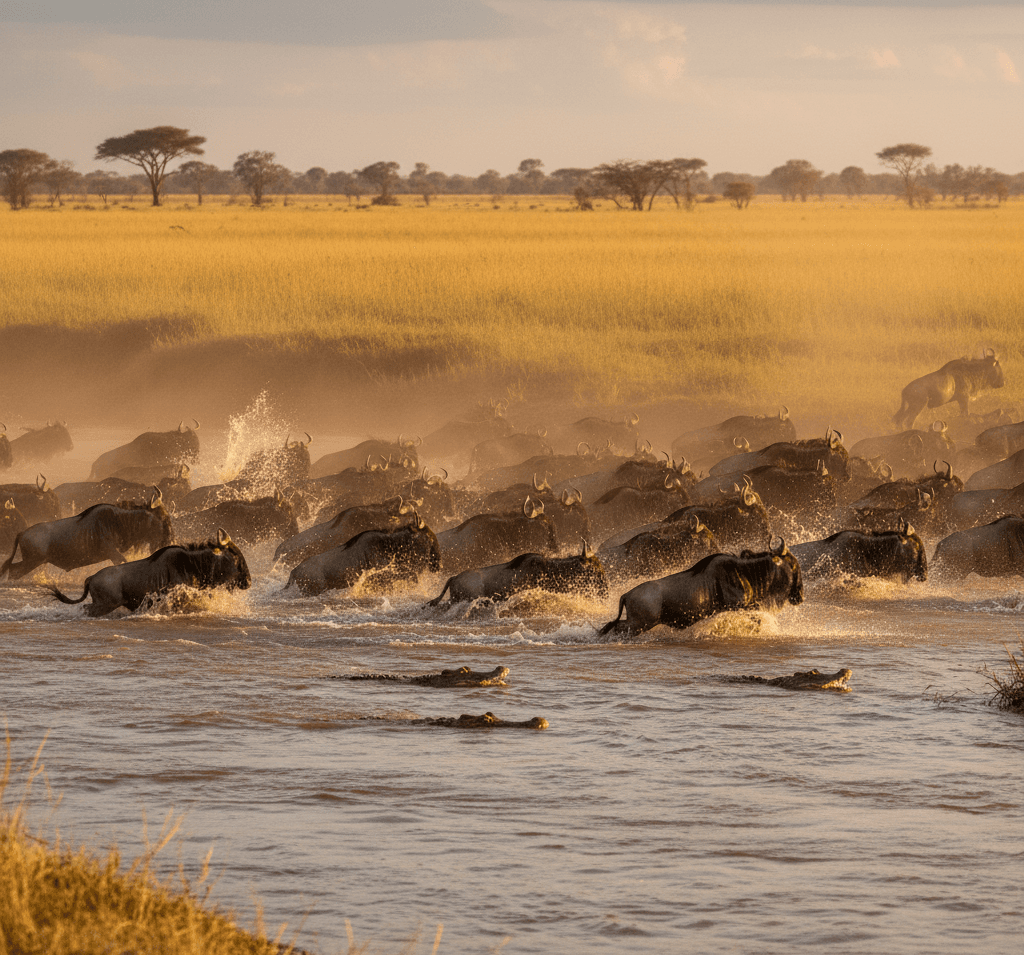
The biggest operational difference between the two countries is the Migration. 1.5 million wildebeest, zebras and gazelles move in a circle between Tanzania and Kenya throughout the year.
Simplified calendar:
- January–March: herd in southern Serengeti (Ndutu) — calving season, active predators
- April–May: herd moving up, heavy rain, low lodge rates
- June–July: herd in northern Serengeti, first Mara River crossings
- August–October: herd in the Masai Mara, dramatic Mara River crossings
- November–December: return south, short rains
The rule we give: if your window is July to October, go to Kenya (Mara). If it's January to March, go to Tanzania (Ndutu). Other months depend more on style.
Each country's classic itinerary
Kenya (8–10 days)
- Day 1: arrival in Nairobi, dinner in Karen (visit the Giraffe Center if there's time)
- Days 2–3: domestic flight to Amboseli (Kilimanjaro view, elephants)
- Days 4–6: flight to Masai Mara (the classic savanna)
- Days 7–9: flight to Lamu or Diani Beach (indigenous Swahili coast)
- Day 10: return via Nairobi
Tanzania (10–12 days)
- Day 1: arrival at Kilimanjaro Airport, transfer to Arusha
- Days 2–3: Tarangire (elephant herds, baobabs)
- Days 4–5: Ngorongoro Crater (260 km² caldera with concentrated megafauna)
- Days 6–8: central or northern Serengeti (depending on season)
- Days 9–12: flight to Zanzibar (Stone Town + beach)
Tanzania requires one or two extra days beyond Kenya due to internal logistics.
What a real safari costs
The safari price range is huge — from USD 300 to USD 3,000 per person per day. Three reference tiers:
Kenya, "comfort tented camp" standard, 8 days
- Brazil–Nairobi round-trip flight: USD 1,700 to 2,400 per person
- 7 nights at camps + domestic flights + safari: USD 9,000 to 15,000 (couple)
- Extras: USD 1,000 to 2,000 (couple)
Total: USD 13,000 to 22,000 per couple, 8 days.
Tanzania, "premium lodges" standard, 10 days + Zanzibar
- Brazil–Kilimanjaro round-trip flight: USD 1,900 to 2,700 per person
- 9 nights at lodges + domestic flights + safari + Zanzibar: USD 14,000 to 26,000 (couple)
- Extras: USD 1,200 to 2,400 (couple)
Total: USD 20,000 to 35,000 per couple, 10 days.
Ultra-luxury, either country (And Beyond, Singita, Bushtops, Cottar's 1920s)
USD 1,500 to USD 3,000 per person per day, full board + safari + transfers. Easily lands at USD 50,000 to 80,000 per couple for 8 days.
When to go
Ideal windows by country:
- Kenya: July to October (Migration in the Mara) is peak. January–February also excellent (dry climate, animals concentrated).
- Tanzania: January–March (south Serengeti, calving) or June–October (north Serengeti, migration).
In April and May it rains heavily in both countries. Rates drop 40%, but some roads become impassable. For experienced travellers, it's great value; for a first trip, avoid.
Family with kids: which is easier
Kenya is simpler for families:
- Shorter domestic flights (1h vs 2h)
- More family-friendly lodge options
- Beach (Diani) accessible by road
- Medical airlift and medical infrastructure in Nairobi
Tanzania works with kids, but requires more careful planning and lodge minimum ages (some accept only 6+ or 8+).
The three types of safari lodging
Understanding this transforms the perception of the trip.
- Fixed lodge — permanent structures, pool, large rooms, elaborate food. Works for families.
- Permanent tented camp — large tents (with bathroom, king bed, wooden floor) installed for the full season. Comfort similar to a 4★ hotel, but immersive.
- Mobile camp — tents pitched and struck as the migration moves. You sleep where the animals are. Purer experience, less comfort.
The combination we recommend for couples: one night in a fixed lodge + two nights in a tented camp + one night in a mobile camp (if the season allows).
The most common mistakes
- Booking "package" safari online without checking lodges — some cheap packages put you in camps surrounded by six other vehicles at a lion sighting.
- Underestimating domestic flights — small Cessna, 15 kg luggage limit, strict rules. Use a soft bag, not hard.
- Ignoring malaria — prophylaxis is mandatory in both countries. See a tropical medicine doctor 30 days ahead.
- Late e-visa — Kenya requires eTA online at least 7 days ahead. Tanzania has visa-on-arrival, but the pre-arranged eVisa saves 30 minutes at arrival.
- No binoculars — most of the safari is observation at 100–300m. Without binoculars, you lose 60% of the experience.
The final call
If this is your first trip to the continent, with a July–October window, seeking classic: Kenya.
If it's your second African trip or you want maximum variety in a single trip: Tanzania.
If it's a honeymoon couple: Tanzania + Zanzibar is probably East Africa's most romantic itinerary.
If it's a family with younger kids: Kenya + Diani Beach is easier to operate.
Where our consultancy comes in
Safari is the kind of trip where the wrong lodge costs 30% of the experience. We've worked with local operators in both countries for over a decade — we know which camp has the best sunset, which guide is a leopard specialist, which route avoids the most touristed areas. For a serious safari, chat with our consultancy is usually the step that separates a common trip from an unforgettable one.